
A water-damaged business does not face a simple choice between operating normally and closing completely. An office may lose one floor but retain its systems. A retailer may have a dry sales area but unsafe stock access. A restaurant may look presentable while drainage, refrigeration or hygiene controls remain compromised.
The useful question is therefore not “Can we open?” It is “What is the smallest safe, lawful and credible version of this business that can operate while recovery continues?” That becomes the centre of the continuity blueprint.
Continuity is controlled adaptation: preserve the outputs that matter without transferring water, electrical, contamination or service risks to staff and customers.
Draw the Minimum Viable Operation
List the few functions that must continue to protect customers, income, contracts or regulated duties. Do not begin with rooms. Begin with outputs: answering priority enquiries, processing orders, maintaining secure records, caring for booked clients, protecting temperature-controlled stock or meeting a dispatch deadline.
Give each critical function five fields: the latest acceptable restart point, people required, systems or equipment required, safe workspace required and an available substitute. A substitute might be remote work, another branch, temporary storage, redirected calls, outsourced fulfilment or a reduced appointment list. Record who can approve the change.
| Business setting | Function to protect | Possible controlled substitute |
|---|---|---|
| Office | Communications, data access and payroll | Remote team with secure access and redirected calls |
| Retail | Orders, stock security and customer collection | Online fulfilment or collection from an unaffected branch |
| Hospitality | Food safety, refrigeration and bookings | Limited service only after relevant hygiene controls are confirmed |
| Salon or clinic | Safe treatment space, records and appointments | Reduced bookings at a suitable alternative location |
| Warehouse | Safe access, inventory control and dispatch | Isolated stock zone or temporary third-party fulfilment |
These are planning examples, not automatic permissions to trade. Sector-specific safety, licensing, hygiene, privacy and contractual requirements still apply.
Choose One of Four Operating Modes
Mode A — Unaffected-zone operation: the business uses a demonstrably separate part of the premises. The route, utilities, fire precautions, welfare facilities and air environment must remain suitable; a strip of barrier tape does not create independence.
Mode B — Reduced on-site service: fewer products, appointments or staff are handled within a verified safe area. Publish the reduced offer accurately and prevent staff from entering the affected zone to retrieve “just one item”.
Mode C — Displaced operation: priority functions move to remote work, another branch or a temporary facility. Confirm data security, insurance, equipment transport, accessibility and any permission required at the alternative location.
Mode D — Controlled pause: trading stops while the business protects records, stock, customer relationships and cash flow. A planned closure with frequent updates can be less damaging than an unsafe reopening followed by a second closure.
The selected mode can change as evidence improves. Record why it was chosen, what would cause escalation and the conditions required to move towards normal operation.
Build a Safe-Zone Boundary That Works
A commercial site should be mapped by function and risk. Include entry routes, emergency exits, electrical distribution, water and drainage, staff welfare, ventilation, stock movement and contractor access. The unaffected zone must not depend on a wet electrical circuit, contaminated washroom, obstructed fire route or equipment located inside the work area.
Floodwater and drainage water may contain harmful contaminants. Wet electrical installations and equipment also require competent assessment. Restrict access, brief staff and use physical controls appropriate to the risk rather than relying on a message in a group chat.
Contractors need their own route where possible, plus rules for dust, waste, noise and movement through occupied space. If the recovery work cannot be separated from customers or normal production, the continuity mode needs to change.
Run Five Continuity Tracks in Parallel
- People: account for staff, visitors and contractors; define safe duties, reporting lines, welfare arrangements and who is authorised to enter restricted zones.
- Premises: stop the source, protect utilities, assess contamination and establish the investigation and drying scope.
- Operations: preserve critical data, equipment, stock, suppliers and customer commitments through the chosen operating mode.
- Finance: notify insurers, preserve invoices and track lost sales, additional expenditure, cancellations and saved costs separately.
- Communication: give staff, customers, landlords, neighbours and delivery partners only the information they need, with one confirmed next update.
Each track needs an owner and a short decision log. This is especially important where a property owner, commercial tenant, managing agent and insurer control different parts of the response. The lease and policies may allocate repairs, access and claims differently; do not let uncertainty about final liability stop immediate risk control.
Treat Stock and Equipment by Consequence, Not Appearance
A dry cardboard box may have stood on a contaminated floor. An apparently working computer may have been exposed to moisture. Packaging, food, medicines, cosmetics, absorbent stock and precision equipment each need decisions based on exposure, cleanability, traceability and sector rules—not whether a cloth removes the mark.
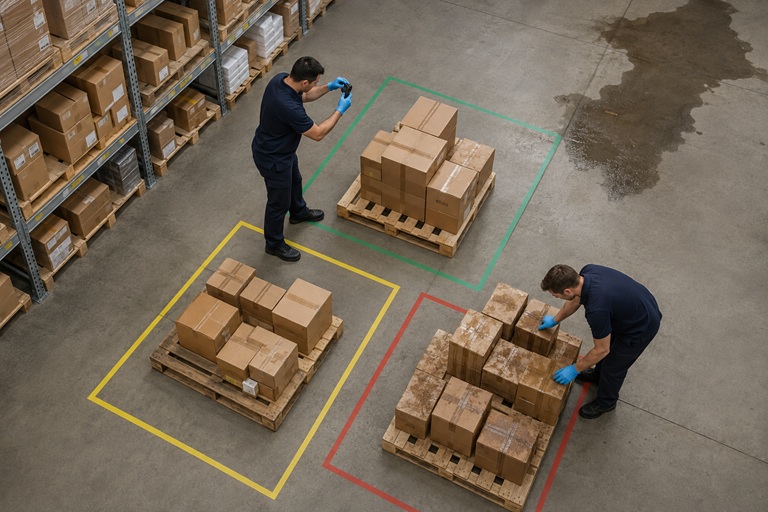
Create three controlled destinations: quarantined for assessment, approved for salvage and documented for disposal. Photograph identifiers, batches and quantities before movement. Keep customer property and business stock separate, and ask the insurer what evidence it requires before material is discarded.
Connect Continuity to the Drying Design
Business priorities should inform the technical response without dictating unsafe shortcuts. A professional commercial water-damage assessment can map affected materials, identify concealed spread and design access around critical areas. Extraction, cleaning, air movement and dehumidification then follow the construction and water source.
Agree where equipment can run, how condensate will drain, which circuits are suitable, what noise or heat it creates and when readings will be reviewed. A noisy drying unit beside a treatment room or customer-service line may technically operate while making the continuity plan impossible. Equipment placement is therefore both a drying and operational decision.
Document the Cost of Each Workaround
Commercial property and business-interruption cover vary substantially. Notify the insurer promptly and ask how buildings, tenant improvements, contents, stock, additional expenditure and interruption are treated. Do not assume that physical-damage acceptance automatically settles every lost-income or relocation cost.
For each workaround, record the problem, options considered, chosen action, approval, cost and effect on turnover or service. Preserve sales history, bookings, payroll, supplier charges, cancelled orders and temporary-site expenses. London Water Damage can support the technical property file through its commercial insurance-claim documentation service; financial losses should be prepared with the appropriate insurer and professional advisers.
Pass Five Gates Before Reopening Each Area
- Safety gate: people can enter without uncontrolled electrical, structural, contamination or access risks.
- Service gate: required utilities, drainage, ventilation, alarms and welfare facilities are available and verified.
- Material gate: retained construction has suitable drying evidence and no affected concealed area has been ignored.
- Operational gate: the area supports its intended work without conflict with contractors, equipment or restricted routes.
- Compliance gate: sector-specific inspections, cleaning, testing, permissions or records are complete.
Apply the gates to individual areas rather than waiting for one vague “building complete” date. If your London premises needs a combined damage survey and continuity-aware recovery scope, request a commercial water-damage assessment with the floor plan, critical functions and known source details ready.
A business returns successfully when its critical promises are kept inside verified limits. The objective is not to appear normal as quickly as possible; it is to operate deliberately while the premises becomes genuinely normal again.
