
A burst pipe creates two urgent problems. Water escapes into the property while moisture travels beneath flooring, behind skirting boards and into walls or ceilings. Stopping the pipe deals with the source, but it does not remove what has already entered the building.
The first 72 hours are therefore less about rushing towards decoration and more about making disciplined decisions. Safety, documentation, water extraction and measured drying all have their place. Here is how a professionally managed recovery is likely to unfold—and why the sequence matters.
Minute 0–30: Make the Situation Safe
Your first task is to stop more water entering the property, provided it is safe to do so. Turn off the supply at the internal stopcock and arrange for the failed pipe or fitting to be isolated. If you use a stored-water system, water may continue to run for a while even after the mains supply has been closed.
Electricity must be treated with particular caution. Do not step into standing water to reach a consumer unit, switch or appliance. If water has reached electrical fittings, leave the affected area and obtain qualified advice. A supply should only be isolated when the controls can be reached without entering water or touching wet equipment.
Move children and pets away, and prevent people from walking through the damaged rooms. If a ceiling is bulging, keep clear of the area below it: waterlogged plasterboard and weakened finishes can fall. Safety takes priority over belongings or cleanup.
Minute 30–120: Preserve Evidence, Not Just Possessions
Once the danger is controlled, record what happened before the scene changes. Take wide photographs of each affected room, then closer images of the pipe, staining, wet finishes and damaged belongings. Note when the leak was discovered, when the water was shut off and any emergency work completed.
If you intend to make an insurance claim, contact your insurer promptly and follow the instructions in your policy. Avoid throwing damaged items away until they have been photographed and your insurer has confirmed how they should be handled. London Water Damage can also provide assistance with water-damage insurance documentation when restoration work forms part of a claim.
Furniture, rugs and undamaged possessions may be moved away from the wet area if this can be done safely. Do not start lifting fixed flooring, opening ceilings or disturbing contaminated materials without first understanding what is involved. Unplanned removal can spread damage, destroy useful evidence or create an avoidable safety risk.
Hour 2–6: Find Out Where the Water Travelled
A burst pipe rarely wets only the surface directly beneath it. Water follows gaps, service routes and changes in floor level. It can run behind kitchen units, soak insulation, collect between floors or emerge in a room some distance from the original failure. A dry-looking edge is not reliable proof that the moisture stopped there.
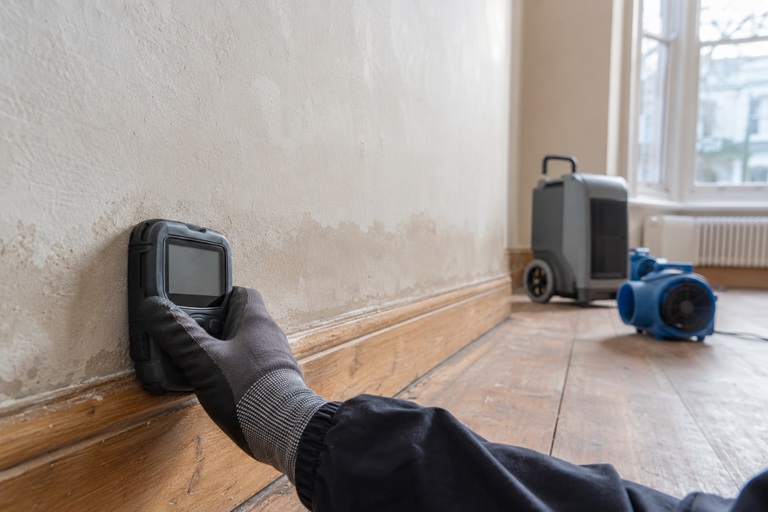
During the initial assessment, the restoration team maps the affected area and considers the property’s construction. Moisture readings identify which walls, ceilings, floors and adjoining spaces require attention. The source and cleanliness of the water also influence what can be retained or removed.
Standing water should then be extracted with equipment suited to the volume and location. This is different from simply mopping the visible floor. Professional water damage restoration addresses both the water you can see and moisture held within the building fabric.
Hour 6–12: Turn an Emergency Into a Drying Plan
After extraction, the property may look considerably better while still containing a significant amount of moisture. This is the point at which a planned drying system replaces emergency water removal. Dehumidifiers remove moisture from the air, while carefully positioned air movers encourage evaporation from wet surfaces and materials.
The correct arrangement depends on room volume, temperature, ventilation, the materials affected and the amount of water involved. More equipment is not automatically better. Poor positioning can leave stagnant pockets, and uncontrolled ventilation can reduce the effectiveness of certain drying setups. Where equipment is needed without broader building repairs, professionally arranged dehumidifier hire in London can provide an appropriate package and installation.
A baseline set of readings should be recorded before drying progresses. That gives the team something objective to compare during later visits. Without monitoring, equipment may be removed because a room feels comfortable rather than because the affected materials have reached a suitable condition.
Hour 12–24: Watch How Different Materials Respond
The first day often reveals how far the damage has developed. Paint may blister, plasterboard can soften and laminate edges may begin to swell. Timber flooring may not show its full reaction immediately because moisture can remain beneath the boards or within the subfloor. Insulation enclosed inside a wall or ceiling can also stay wet after the exposed surface has started to dry.
This does not mean every marked material must be replaced. Some finishes can be repaired; others lose their strength, shape or hygienic condition. Decisions should reflect the material, saturation, water source and measured progress—not appearance alone.
Occupants should keep drying equipment running as instructed and avoid moving it between rooms. Doors and windows should be managed according to the agreed setup. Switching machines off overnight because of noise or heat can interrupt the drying cycle and extend the overall recovery.
Hour 24–48: Measure Progress and Adjust
By the second day, the focus shifts from initial response to evidence-led control. Repeat moisture readings show which areas are improving and which remain stubbornly wet. Equipment positions or settings may be adjusted, additional access may be required, and materials that are preventing effective drying can be reconsidered.
Hidden moisture deserves particular attention around skirting lines, fitted cupboards, floor junctions and the room below the leak. A ceiling stain may dry at the surface while the void above remains damp. Similarly, carpet can feel nearly dry while the underlay continues holding water against the subfloor.
Normal household heating or a domestic fan may improve comfort after a very small incident, but it cannot confirm that the structure is dry. The purpose of monitoring is to prevent a cosmetic finish from concealing moisture that later causes odours, staining, deteriorating plaster or mould growth.
Hour 48–72: Define the Repair Scope
At the 72-hour point, some properties will be drying well; others will only be partway through the process. A small, quickly isolated pipe leak affecting a hard surface is very different from water that has crossed several rooms, entered a floor void or remained undiscovered overnight. The clock does not decide when repairs can begin—moisture readings do.
By now, however, the likely repair requirements should be much clearer. The scope might include local plaster repairs and redecoration, or it may extend to damaged ceilings, wall finishes, insulation, joinery and flooring. For extensive domestic incidents, coordinated residential flood repair can carry the property from strip-out and drying through to reinstatement.
A useful repair plan distinguishes three groups: materials that can remain, materials requiring further drying and materials that must be replaced. This prevents premature work and creates a clearer basis for quotations, insurer communication and scheduling.
Beyond 72 Hours: Dry First, Restore Second
The next stage is determined by the property rather than a standard timetable. Drying may continue with regular monitoring until the affected materials reach appropriate levels. Only then should plastering, flooring installation, joinery repairs or decorating be completed. Sealing a damp wall with fresh paint may briefly hide the evidence, but it does not resolve the moisture beneath it.
What makes the first 72 hours successful is not frantic activity. It is the orderly handover from safety and containment to assessment, controlled drying and a repair plan supported by evidence. If a burst pipe has affected your London property, you can request an on-site water-damage assessment and receive guidance on the drying and restoration work required.
