
Speed matters after water enters a period home, but speed and haste are not the same thing. Standing water, unsafe services and an active leak require prompt action. Removing lime plaster, lifting original boards or sealing a damp wall are different decisions: they may permanently change fabric that could have recovered.
Traditional buildings manage moisture through materials and assemblies that are often more permeable than their modern equivalents. Their recovery plan must account for how the structure was built, what has been altered and which features contribute to its character. A standard strip-out specification can therefore create more loss than the water itself.
The following five vetoes are deliberate pause points. Each stops an irreversible instruction until the necessary evidence, authority and compatible method are in place.
Before the Vetoes: Draw a Significance Sketch
Start with a simple plan of the affected rooms. Mark the water source and spread, then identify original or potentially significant features: lime plaster, lath-and-plaster ceilings, timber boards, panelling, joinery, fireplaces, decorative finishes, stone and historic ironwork. Include modern additions because an impermeable coating or later concrete floor may alter how adjacent traditional fabric dries.
Do not guess the age or importance of a material from appearance alone. Record uncertainty. A conservation-accredited professional or experienced surveyor can help identify construction, assess significance and distinguish repairable historic material from later work. For a listed building, contact the local authority conservation officer about emergency measures and permanent proposals.
Veto One — No Wholesale Strip-Out Before Material Identification
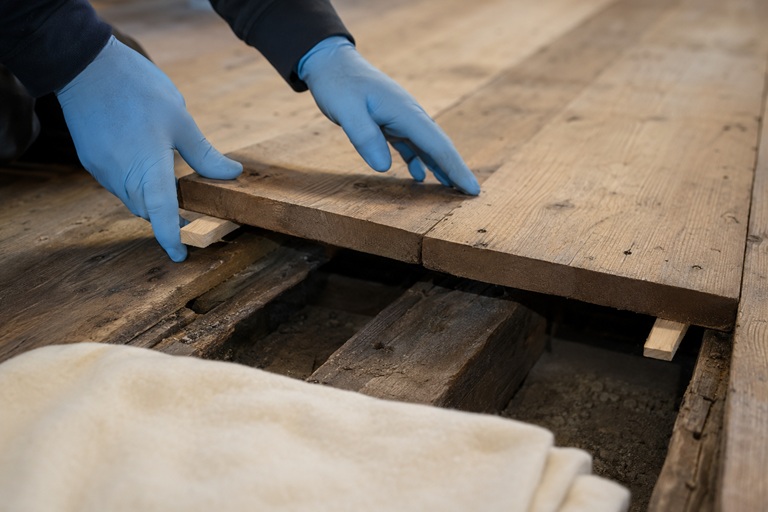
Strip-out makes wet surfaces accessible, but access is not the same as justification. Historic England advises that removing lime plaster does not necessarily make a wall dry faster and that old timber floors can often be cleaned and dried in suitable conditions. A saturated modern composite board and a wet, well-seasoned floorboard should not receive the same verdict.
- Leave safely in place when the material remains stable and can be monitored.
- Create limited access where a small opening can reveal a void or permit drainage without sacrificing an entire finish.
- Lift and retain when careful removal is necessary but sound pieces can be numbered, dried and reinstated.
- Remove locally where failure, contamination or loss of integrity is demonstrated.
- Replace extensively only when the evidence and approved repair method justify the wider loss.
Photograph every stage. Store retained pieces in a controlled, traceable way rather than stacking wet boards or mouldings where they may distort, become mixed or be discarded as ordinary waste.
Where removal is approved, establish a sample shelf before work expands. Retain representative moulding profiles, paint layers, floorboard sections and fixing details where this is safe and appropriate. These references help the repair team match dimensions and materials without relying on memory after the room has been cleared. They also show the insurer and conservation adviser exactly what the replacement specification is intended to reproduce.
Veto Two — No Aggressive Drying Chosen by Calendar Alone
Traditional fabric can be damaged by an unsuitable drying environment. Excessive local heat or rapid changes may contribute to movement, cracking, salt activity and distortion in susceptible materials. The goal is controlled moisture reduction, not the highest possible room temperature or the earliest equipment collection date.
A drying design should describe the construction, environmental conditions, equipment arrangement and monitoring points. Air movement may need to be gentle around fragile finishes. Timber, plaster, masonry and decorative work can respond at different rates, so the slowest or most sensitive element may control the programme.
Record every material intervention separately from equipment changes. If a board is lifted, a vent opened or a coating removed, note the date and reason. Otherwise, an improved reading may be credited to a dehumidifier setting when the real change was newly created evaporation access.
Professional structural drying after water damage should also account for concealed modern layers. Vinyl finishes, dense paint, foil-backed insulation or later tanking may restrict evaporation even where the visible historic surface appears permeable.
Veto Three — No Single Meter Reading Declares the Building Dry
Moisture instruments do not all measure the same thing, and salts, density, metal or previous treatments can influence certain readings. A number taken from one wall should not be treated as a universal percentage for plaster, brick, stone and timber throughout the property.
Use repeatable locations, appropriate instruments and comparable unaffected material where possible. Record the trend alongside room temperature and relative humidity. The question is not only “what is today’s reading?” but “is this element changing as expected, and is the result consistent with its condition and construction?”
Visual evidence still matters. New cracking, lifting paint, salt deposits, softness, joint movement and timber deformation should be logged and reviewed. A stable environmental reading cannot overrule material deterioration that needs investigation.
Veto Four — No Modern Substitute Merely Because It Is Available
A repair can look finished while changing the way a wall or floor handles moisture. Dense cement-rich mortars, gypsum systems, waterproof coatings and impermeable paints may be inappropriate for some traditional assemblies. Restricting evaporation can retain water within masonry or redirect it towards timber and adjoining fabric.
| Original element | First repair question | Evidence required |
|---|---|---|
| Lime plaster | Can it remain, consolidate or receive a compatible local repair? | Bond, contamination, cracking and moisture trend |
| Timber floorboards | Can boards be cleaned, gradually dried and refixed? | Condition of boards, joists, fixings and subfloor void |
| Traditional masonry | Which mortar and finish will preserve moisture movement? | Wall construction, existing materials and salt condition |
| Decorative joinery | Can local repair retain more original material than replacement? | Profile, timber condition, movement and finish analysis |
| Historic ceiling | Can temporary support and specialist repair prevent wider loss? | Lath, fixing and plaster stability assessed from safe access |
Compatibility does not mean reproducing every historic method without question. The repair must satisfy safety, performance and regulatory needs while retaining significance. That requires a considered specification, not an automatic swap from an old material to the contractor’s usual modern system.
Veto Five — No Permanent Work Before Authority and Scope Agree
Emergency work may be necessary to keep people safe, stop water and prevent further loss. Permanent alteration is a separate stage. Listed building consent may be required where repairs remove historic fabric or affect the building’s special character. Requirements depend on the building and proposal, so obtain project-specific advice rather than assuming that insurance approval also provides planning authority.
Create two clearly labelled schedules: temporary protection and proposed permanent repair. Give the conservation adviser, insurer, loss adjuster and contractor the same photographs, significance sketch and material decisions. London Water Damage can support this evidence chain through its water-damage claim documentation, while the relevant authority determines heritage consent.
Close the Project With a Fabric Retention Register
The final record should state what was present, what became wet, what was retained, what was removed and why. Attach drying trends, trial-repair results, consent records, product information and photographs of concealed work. Where original pieces were lifted and returned, show their final locations.
Include future care. Note breathable finishes, ventilation needs, inspection points and any area that should not receive an impermeable coating later. A short explanation can prevent a well-intentioned decorator or future owner from undoing the recovery strategy.
If a period or listed London property has suffered a leak or flood, request a fabric-aware water-damage assessment before extensive removal begins. The most successful restoration may be defined as much by what remains in the building as by what looks newly repaired.
